
Jump to:
How to activate check-in/out
Check-in confirms that a booked space is being used. Check-out lets users end a booking early and free the space for someone else.
Go to Settings > Space types, open a type, select Groups, and click Edit for the group you want to configure. Open the Check-in tab.
Turn on Require check-in, then choose the methods users can use:
- Simple: users check in from the web app, Teams, or the mobile app.
- WiFi: automatic check-in when the device connects to the configured office network.
- QR code scan: users scan the code at their space with the YAROOMS mobile app.
- Geo-fenced: users can check in within the configured radius of the location’s address.
Turn on Allow check-out if users should be able to release their space before the booking ends. Click Save changes when finished.
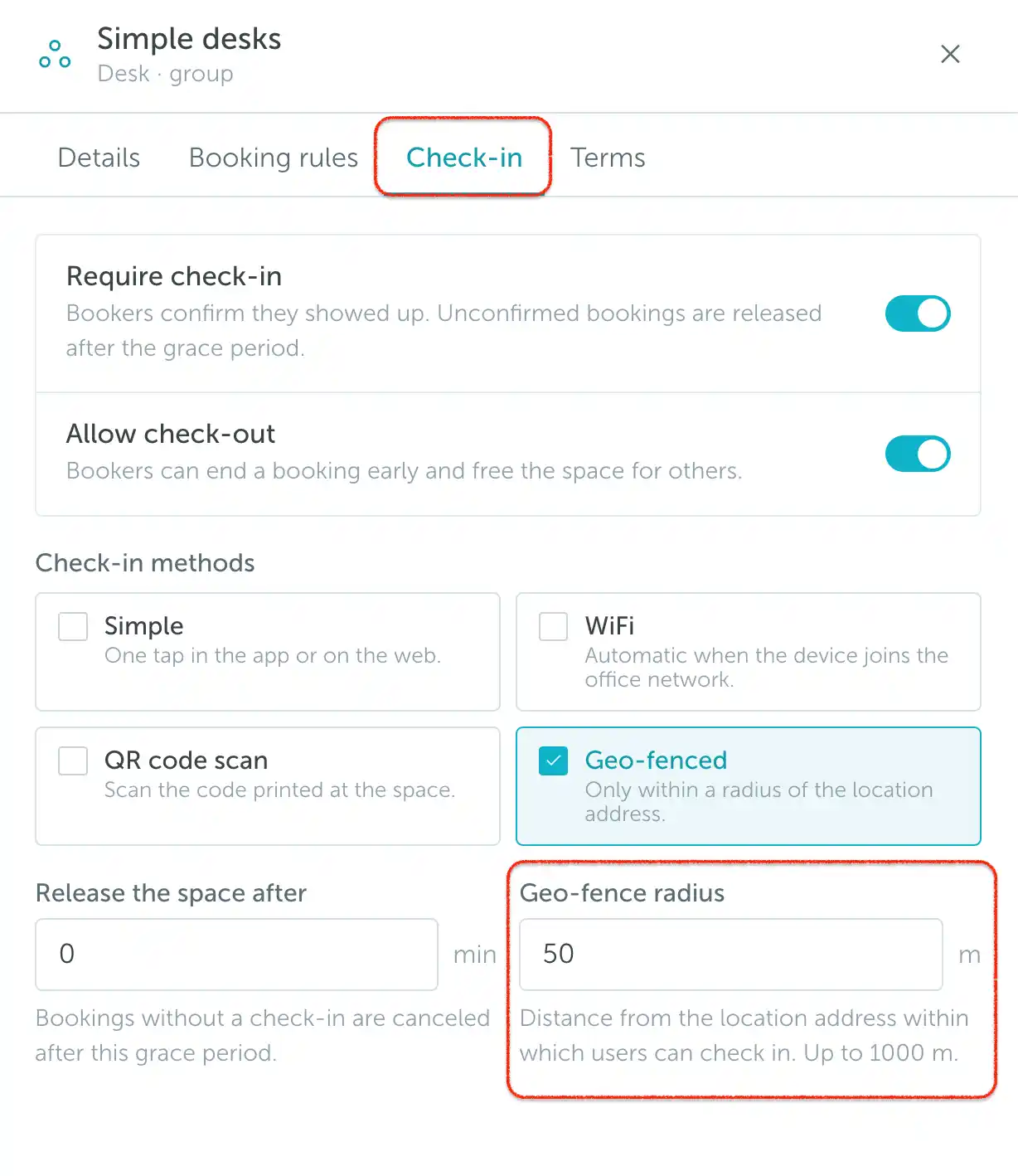
Check-in rules apply to the space group. Use separate groups when different desks or rooms need different check-in methods.
You can enable multiple methods. Users do not need to complete every method: the first applicable method that satisfies its requirements registers the check-in.
Geo-fenced requirements
First, set the office address in Settings > Workplace > select location > Edit location > General. Under Address & locale, click Edit details, enter the address, then click Done and Save changes.
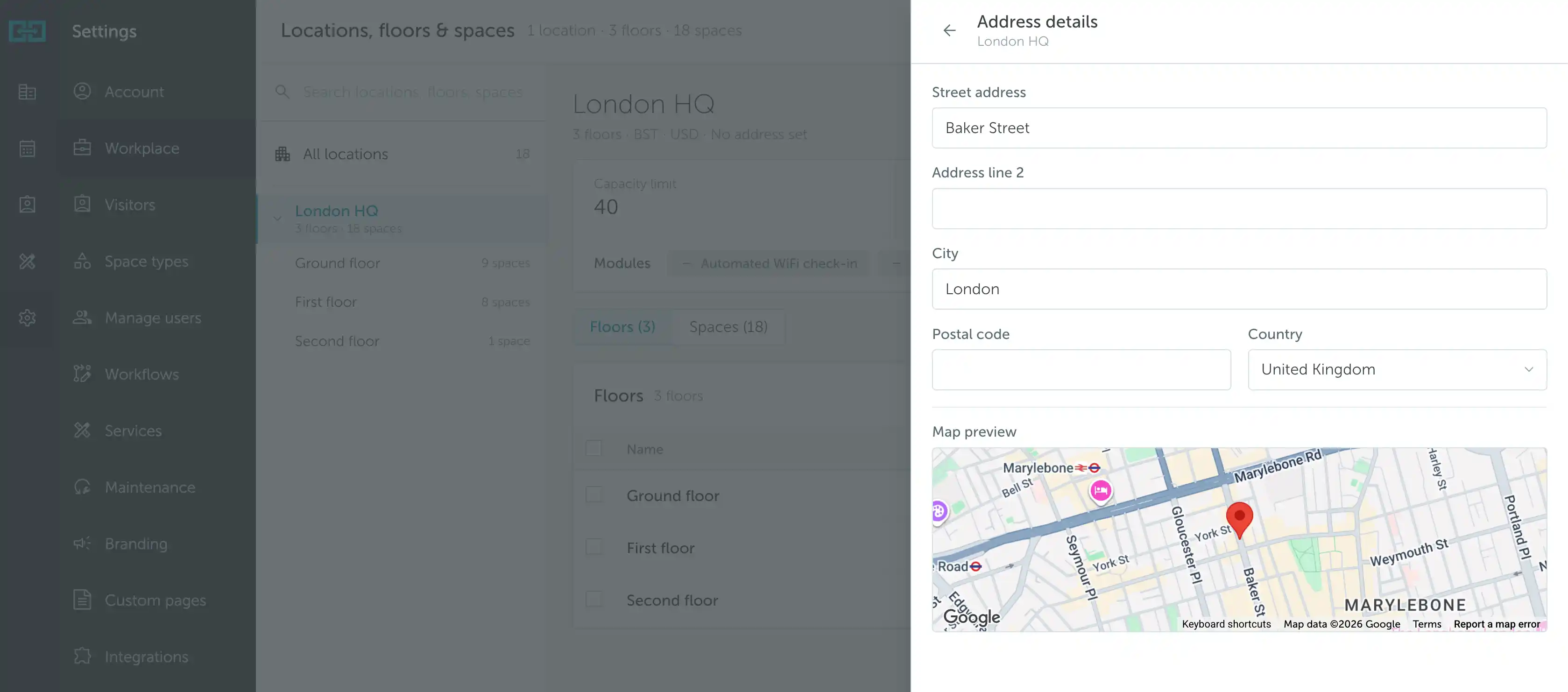
Return to the space group’s Check-in tab, select Geo-fenced, and enter the Geo-fence radius in meters. The maximum radius is 1,000 m. Save your changes.
Geo-fencing restricts where users can check in; it is not the same as automatic Wi-Fi check-in. For the mobile steps, see How to check in on mobile.
Automated Wi-Fi check-in requirements
Open Settings > Workplace > select location > Edit location > Modules and enable Automated WiFi check-in.
Note: The module is unavailable until the location has a saved address. Add it in the General tab first, then return to Modules.
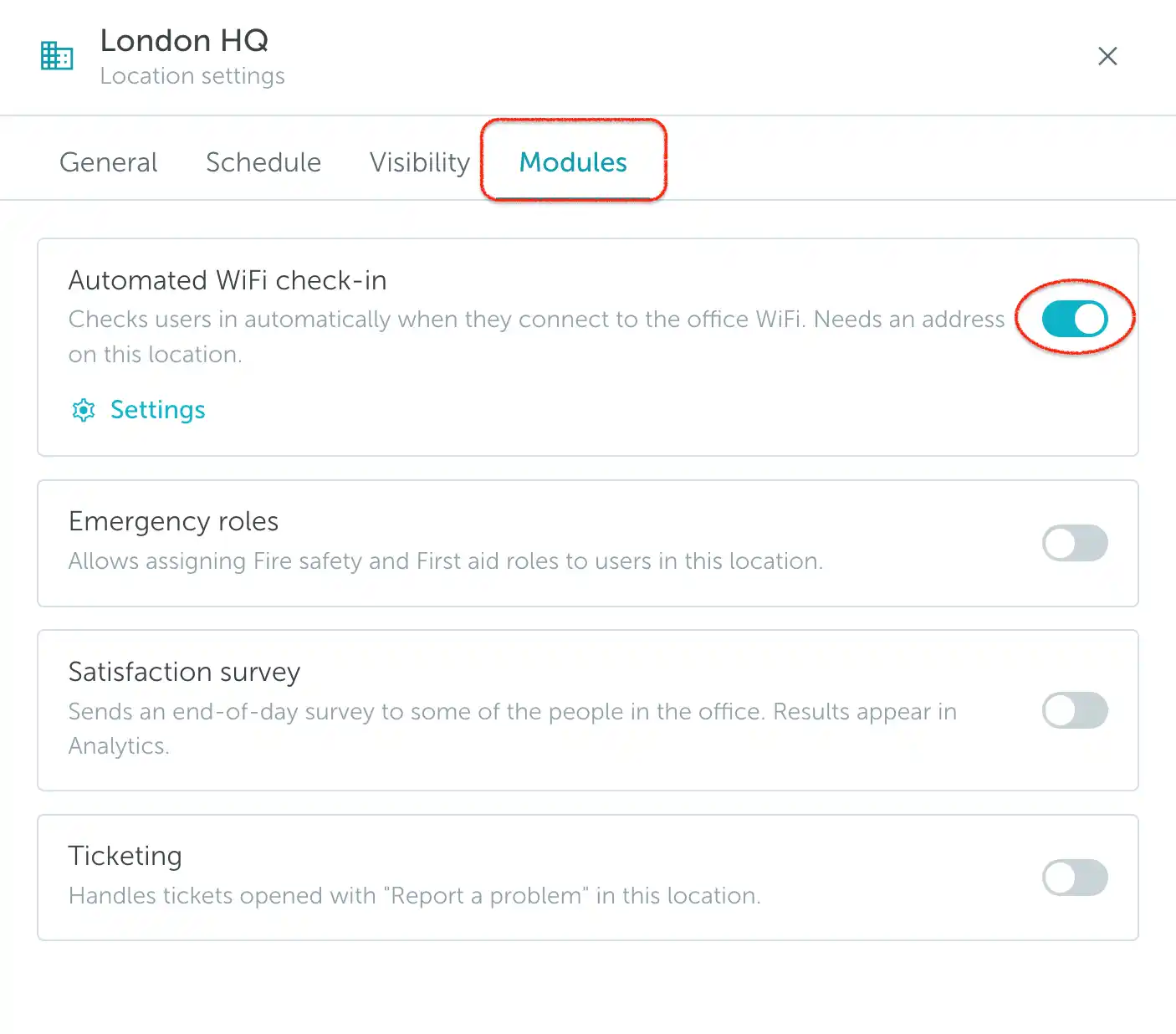
Configure the location’s public IP addresses in the module settings. Each entry needs a label and an IP address in CIDR format, including its mask. For example, 203.0.113.10/32 illustrates a single-address entry; replace it with your office’s actual public IP address.
Save the location settings, then select WiFi in the relevant space group’s Check-in tab and save its changes too.
Ask your IT team for the office network's public IP addresses and masks. Use those addresses, not a device's private network address.
Setting the grace period
In the group’s Check-in tab, use Release the space after to set the grace period in minutes. The countdown starts when the booking begins.
Warning: Bookings without a check-in are canceled when the grace period expires, making the space available to others. For example, a booking starting at 9:00 AM with a 15-minute grace period is canceled at 9:15 AM if nobody checks in.
Set the grace period to 0 to allow check-in at any time during the booking instead of canceling it after a timed grace period.
How to print the QR codes
Go to Settings > Workplace. Use All locations to see every space, select a location and open Spaces, or select a floor. Use the search and space type/group filters to narrow the list, then click Print QR codes above it.
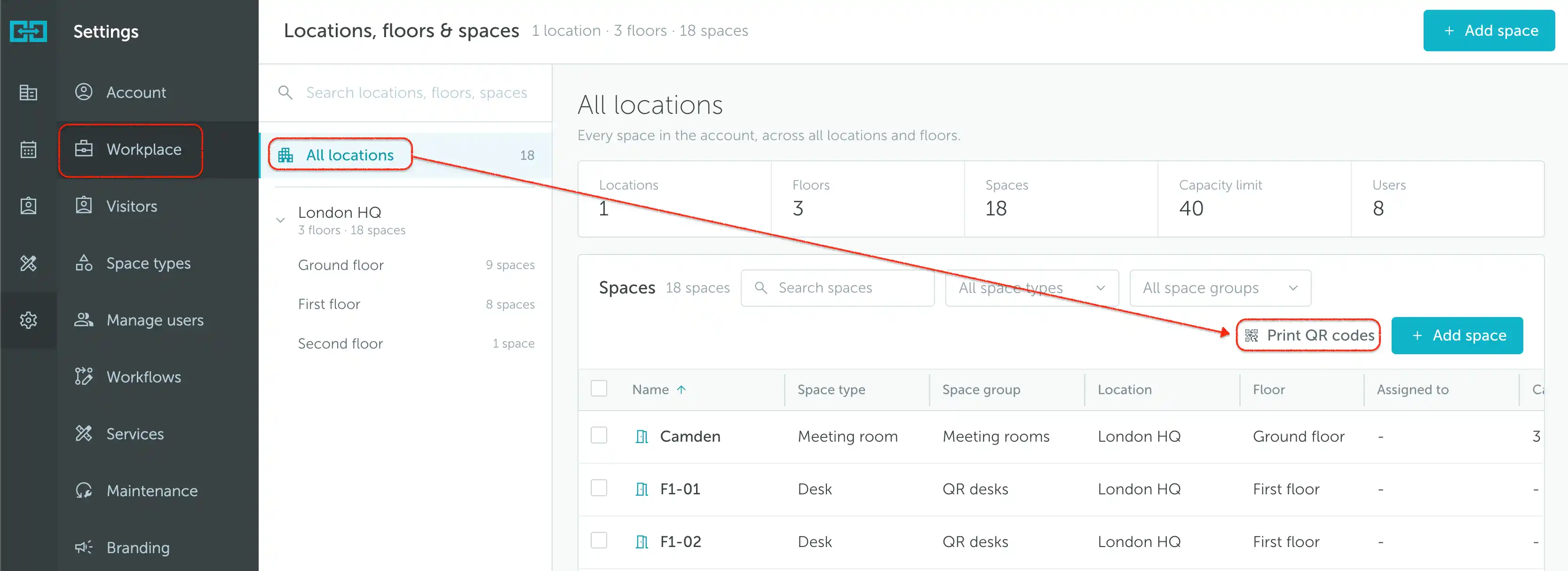
In the dialog, check the number of spaces, choose the No. of columns and No. of rows, then click Continue to proceed to printing. The preview text shows how many pages the layout will use.
Place each code at its corresponding space. Make sure QR code scan is enabled in that space’s group if you want users to check in this way.
Who can check in on behalf of others
Check-in on behalf of another user depends on the person’s role and permissions:
- Administrators and Supervisors can check in for any user.
- User Team Managers can check in for users in the team they manage.
- Direct Managers can check in for their direct reports.
- Custom roles need the corresponding administrative permission.
For the user-facing steps, see How to check in / check out.