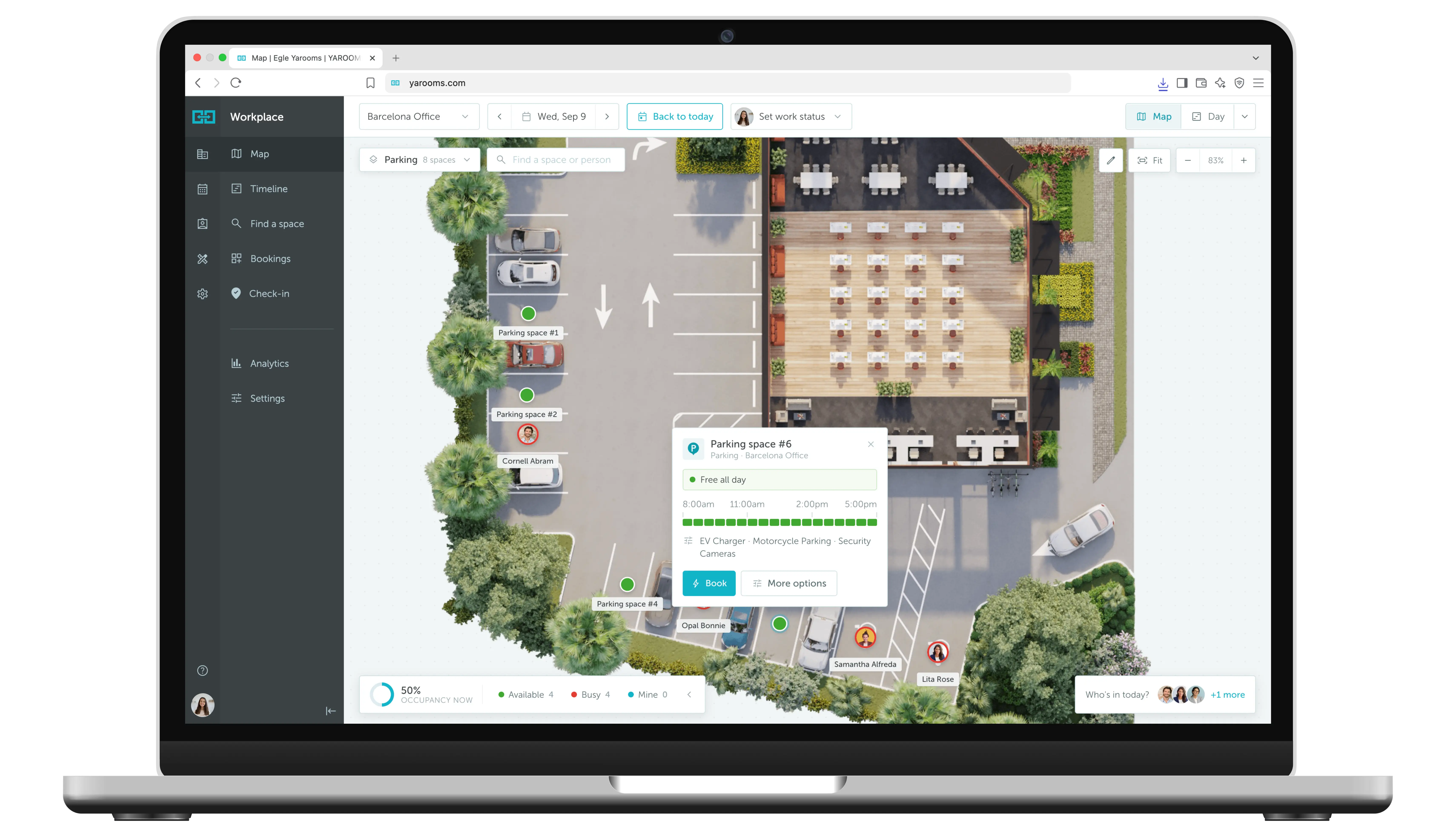
Smart parking management for the modern office

Employee parking reservation system providing guaranteed spots while optimizing lot utilization. Book parking alongside desk and room reservations.

Watch tour
Smart parking management for the modern office

Trusted by innovative organizations worldwide

Verizon
Dr. Martens
Columbia University
Dedalus
Cerved
ASEE
University of Sydney

Complete parking management

Everything you need to manage office parking

Advance Booking

Reserve parking spots ahead of office visits. Guarantee your space before you leave home.

Interactive Lot Maps

Visual parking maps showing real-time availability. Select your preferred spot from the map.

Permanent Assignments

Support both bookable and permanently assigned parking spots. Flexible options for different employee needs.

Unified Booking

Book parking alongside desk and room reservations in one flow. Complete your office day planning in one place.

EV Charging Spots

Filter for parking spots with EV charging stations. Support your sustainability initiatives.

Utilization Analytics

Understand parking usage patterns. Optimize lot allocation based on actual demand data.

Mobile Access

Book and manage parking from the mobile app. Check availability on the go.

Visitor Parking

Allocate visitor parking as part of guest registration. Seamless experience for your guests.

How it works

1

Check availability

View real-time parking availability on interactive lot maps.

2

Reserve your spot

Book parking for the day or in advance alongside workspace reservations.

3

Arrive with confidence

Your guaranteed spot is waiting. No more circling the lot.

Key Benefits

Guaranteed parking spots
Real-time availability
Unified booking experience
EV charging support
Visitor parking management
Mobile access
Utilization analytics
Reduce parking stress
G2 Users Love Us G2 Highest User Adoption G2 Easiest Setup Capterra Capterra Shortlist 2025 GetApp Category Leaders Software Advice Front Runners

Parking booking systems: FAQ

Answering the most popular questions about parking booking systems in the office:

A parking booking system is a digital solution designed to facilitate the reservation of parking spaces through software or online platforms. These systems allow users to search for, reserve, and sometimes pay for parking spots in advance, either through a website, a mobile app, or another digital interface. Here are some key features and benefits of parking booking systems:

  1. Online Reservations: Drivers can book parking spaces online before reaching their destination, ensuring a guaranteed spot upon arrival. This is particularly useful in crowded urban areas, airports, corporate offices, event parking spots, and tourist attractions.
  2. Real-time Availability: The system provides real-time information on the availability of parking spaces and their location number, helping users avoid the hassle of searching for a spot in full or overcrowded parking garages.
  3. Time and Cost Efficiency: By allowing parking lot pre-booking, these systems can save time for the users and potentially offer discounts for advance payments or long-term bookings, making parking cars more cost-effective.
  4. Access Control and Security: Integrated with access control systems, parking booking systems can enhance the security of parking facilities by restricting access to only those vehicles and their drivers who have made reservations.
  5. Efficient Space Management: These systems provide valuable data on parking lot and parking garage usage patterns for operators, helping them manage their spaces more efficiently and adjust pricing based on demand.
  6. Eco-friendly: By reducing the time drivers spend searching for parking lots, these systems can contribute to lower carbon emissions, making them an environmentally friendly option.

Overall, parking booking systems aim to streamline the parking process for drivers and operators, offering convenience, efficiency, and improved utilization of parking resources.

Parking management refers to planning, regulating, and administrating parking spaces to ensure optimal use of available parking garage resources. It encompasses a wide range of strategies and practices designed to address the various challenges associated with parking, including scarcity of parking lots, congestion, environmental impact, different types of vehicles, and the needs of drivers. Effective parking management aims to improve parking lot accessibility, reduce car traffic in congested areas, enhance urban mobility, and support sustainable transportation goals. Some critical components of parking management include:

  1. Parking Policies and Regulations: Implementing rules that govern where, when, and how parking is allowed. This can include parking time limits, permit systems, and restrictions in certain areas to prioritize specific needs, such as residential parking or short-term visitor parking.
  2. Pricing Strategies: Adjust car parking fees based on demand, location, and time to manage parking space availability and encourage alternative transportation modes. Parking meters with dynamic pricing models can be employed to reflect peak and off-peak periods.
  3. Technology and Innovation: Utilizing technology to improve parking efficiency and user experience. This includes automated parking systems, mobile app-based payment and parking spot reservation systems, parking meters, and real-time information on parking availability.
  4. Design and Layout: Plan and design vehicle parking facilities (street parking, free parking, event parking, monthly parking etc.) to maximize space utilization, ensure safety, and integrate seamlessly with the surrounding environment. This can involve the development of multi-story parking structures, underground parking, and the use of green vehicle parking solutions.
  5. Sustainability Practices: Implementing eco-friendly car parking practices, such as electric vehicle charging stations, bike parking, and incentives for carpooling or using public transit, to reduce the environmental impact of parking.
  6. Enforcement and Compliance: Ensuring that vehicle parking rules and policies are followed through monitoring, enforcement actions, and penalties for violations.

By effectively managing vehicle parking, cities and organizations can alleviate congestion, improve accessibility, support economic development, and enhance the quality of life for residents, employees, and visitors.

Managing parking problems in an office requires a strategic approach that balances the needs of employees, visitors, and the organization itself. Several strategies can be effectively applied to address parking issues in your office’s garage:

  • Conduct a Parking Lot Demand Assessment: Evaluate current parking lot demand and availability.
  • Implement Flexible Work Arrangements: Encourage flexible work hours or remote work options to manage the driver and vehicle flow in and out your garage.
  • Optimize Parking Space Allocation: Prioritize parking space based on need and implement a location number or permit system.
  • Promote Carpooling and Ridesharing: Offer incentives for carpooling or using rideshare services.
  • Increase Accessibility to Public Transportation: Provide information and subsidies for public transit.
  • Utilize Technology for Parking Lot Management: Implement smart parking solutions for real-time availability and reservations.
  • Expand or Optimize Existing Parking Facilities: Consider expanding or reconfiguring vehicle parking lots to increase capacity.
  • Partner with Nearby Facilities: Negotiate shared vehicle parking agreements with nearby businesses or facilities.
  • Implement a Vehicle Parking Fee: Implement parking meters and ask drivers pay for parking to discourage unnecessary use and fund improvements or alternatives.
  • Foster a Culture of Alternative Transportation: Promote biking, walking, and public transit use with amenities and programs.

By applying these strategies, you can effectively manage vehicle parking problems in the office, ensuring that parking resources are used efficiently and equitably while supporting sustainability and employee well-being.

Calculating the number of parking spaces needed for an office garage involves considering various factors, including local zoning laws, the business’s nature, the building’s size, the number of vehicles and drivers, and expected visitors. Here is a general approach to estimating parking garage requirements for an office space:

  1. Check Local Zoning Regulations: Start by checking local zoning ordinances or regulations, as these often specify the minimum number of parking spaces required per square footage of office space or number of employees. This can vary significantly depending on the location.
  2. Consider the Office Size and Type: The size of the office (in square feet) and the type of office work (e.g., open plan, individual offices, mixed-use) can influence the density of drivers and the need for vehicle parking. More densely populated office spaces may require more parking lots.
  3. Estimate the Number of Employees: Calculate the maximum number of employees working at the office at any given time. This includes full-time, part-time, and any remote workers who might be driving to the office occasionally.
  4. Account for Visitors: Estimate the average number of visitors to the office daily. This could include clients, delivery personnel, and other guests.
  5. Use a Parking Ratio: Parking ratios are often used to estimate parking needs, expressed as the number of parking spaces per 1,000 square feet of office space or employee. For example, a typical ratio might be 3 to 4 parking lots per 1,000 square feet of office space, one space per employee, and additional spaces for visitors.
  6. Adjust for Shared Use and Peak Times: If the office shares parking garage with other businesses or peak times when vehicle parking demand is higher, adjust your calculations accordingly. Shared parking can reduce the spaces needed if businesses have different peak hours.
  7. Consider Alternative Transportation: If the office is in an area with good public transportation, or if there are incentives for carpooling or biking, you might be able to reduce the number of vehicle parking spaces needed.
  8. Plan for Future Growth: Anticipate the company’s future growth and consider adding additional parking lots to your garage to accommodate new employees and business expansion.

To calculate a basic estimate, you can use a formula based on local requirements or industry standards, adjusting as necessary. For example, if the local zoning requires four parking spaces per 1,000 square feet for an office building, and your office is 10,000 square feet, you would need at least 40 parking spaces.

Remember that these are general guidelines, and specific requirements can vary. Always consult with local parking planning authorities and consider hiring a professional planner or architect for precise planning and compliance with local codes.

There are various kinds of parking options available. Garage parking is typical in urban areas, where vehicles are parked in multi-level garages. Some garages may require users to enter a location number to identify their spot and often use parking apps or smartphone payment methods. Parking meters are typically used for street parking, where drivers must pay for parking by the hour. Free parking is available in some areas, such as house parking or public lots. Valet parking allows a valet to park the vehicle for the driver. Underground garages are also standard in city centers. To find parking, many rely on apps that use sensors to detect availability, especially in high-demand locations.
The standard size for a parking space typically ranges from 8 to 9 feet in width and 16 to 18 feet in length. This applies to garage parking, street parking, and house parking. In underground garages, sizes may vary slightly to accommodate different vehicle types. Valet parking services also use standard sizes to ensure efficient car placement.
YAROOMS

Become a partner

Join our growing network of partners worldwide

Application received!

We'll review your details and get back to you soon.

We use cookies to analyze traffic and improve your experience.

Cookie preferences

Essential

Required for the site to function

Always on
Analytics

Help us understand how visitors use the site

Marketing

Used to deliver relevant ads

Talk to Sales or Support