
AI in Workplace Management: What Actually Works in 2026
A practical guide to AI in workplace management: what works, what is hype, and how agents like Yarvis help teams work smarter.
AI is reshaping how organizations manage their physical workplaces, but not every “AI-powered” label means the same thing. In 2026, the most practical AI features in workplace management include natural language booking through agents like YAROOMS Yarvis, predictive space utilization, and smart scheduling for hybrid work. The real value is not futuristic automation. It is eliminating daily friction, finding a desk, booking a room, and seeing who is in the office. If you want broader context first, see AI in Workplace Technology, then return here for the practical playbook.
TL;DR
- Good workplace AI saves time on daily tasks like booking desks, rooms, and coordinating visitors.
- Real AI takes action in your workflow, not just answering like a search bar.
- The biggest wins today are natural-language booking, smarter scheduling, and no-show detection.
- The best tools work in channels people already use, especially Teams and email.
- AI does not replace facilities teams, it removes repetitive admin so they can focus on strategy.
- Adoption matters more than hype, simple user experience usually beats flashy features.
- Teams that start now build better data, and that data becomes an advantage as AI gets more capable.
The AI Reality Check
Let’s be honest: “AI-powered” has become the most overused label in enterprise software. In workplace management specifically, there is a wide spectrum between genuine intelligence and a basic search bar wearing an AI badge.
The numbers tell a clearer story now. Stanford HAI’s 2025 AI Index, citing McKinsey survey data, reports that 71% of organizations used generative AI in at least one business function in 2024. The World Economic Forum reports that 86% of employers expect AI and information processing technologies to transform their business by 2030. In enterprise software, Gartner predicts that 40% of enterprise applications will include task-specific AI agents by the end of 2026, up from less than 5% in 2025.
But not all AI is created equal. Here is how to tell what is real from what is marketing.
What’s real AI in workplace management:
- Natural language interfaces that understand “book me a desk near Sarah on Tuesday”
- Predictive models that forecast office attendance and recommend space adjustments
- Anomaly detection that flags no-shows, underutilized floors, or booking pattern changes
- Automated workflows triggered by real-time conditions (room not checked into? Auto-release it)
What’s marketing AI:
- A search bar renamed “AI agent”
- Basic filtering labeled as “smart recommendations”
- Standard analytics dashboards called “AI-powered insights”
- Any feature that existed before 2024 with “AI” added to the name
The platforms making genuine progress include YAROOMS (Yarvis), OfficeSpace (AI recommendations), Robin (smart scheduling), and Eptura (predictive analytics). Each approaches AI differently, with varying depths of capability. Adoption still depends on people and culture, so this is also worth reading: How Can Leaders Encourage Employees to Use AI in the Workplace?
Five Ways AI Actually Helps in Workplace Management
1. Natural Language Booking
Instead of navigating floor plans and calendar grids, employees ask a question:
- “Find me a quiet desk near the marketing team on Thursday”
- “Book a meeting room for 6 people with a whiteboard, 2pm tomorrow”
- “Where’s the nearest available parking spot?”
YAROOMS Yarvis handles these requests inside Microsoft Teams or email. The agent understands context, it knows your team, your preferences, your building layout, and handles the booking in seconds. This is not theoretical, it is shipping today.
The impact is real: Reuters reports that U.K. administrative workers could save 122 hours per year by using AI tools (Reuters/Google, 2025), and workplace booking is one of the most repetitive admin tasks there is.
2. Predictive Space Recommendations
AI analyzes historical booking and occupancy data to predict:
- Which days will be busiest next week
- Which floors are likely underutilized on Fridays
- When meeting room demand will exceed capacity
OfficeSpace offers machine-learning based desk recommendations that consider team proximity, past preferences, and real-time availability. For side-by-side context, see OfficeSpace alternatives.
This matters because most office space goes wasted. CBRE Global Workplace & Occupancy Insights 2026 found that global office utilization has climbed to 53%, up from 38% in 2024, but that still means nearly half of office space sits empty on any given day. AI that predicts and redistributes demand can meaningfully close that gap.
3. Anomaly Detection and Auto-Release
Meeting rooms booked but empty? AI detects the pattern:
- Automatic release of rooms not checked into within 10 to 15 minutes
- Flagging of recurring bookings with consistently low attendance
- Alerts when booking patterns suddenly shift (indicating a team restructure or policy change)
YAROOMS combines booking data, check-in status, and utilization analytics to identify ghost bookings automatically and reclaim wasted space. CBRE reports that global average utilization reached 53% in 2025, while peak utilization reached 64% in 2024. As offices get busier, AI-driven anomaly detection turns passive reporting into active space recovery.
4. Smart Scheduling Suggestions
Rather than leaving employees to guess the best office days, AI suggests:
- “Your team is mostly in on Tuesdays and Thursdays, book those days for collaboration”
- “Wednesday looks less crowded, ideal for focused work”
- “Three of your meeting attendees are remote next Monday, consider a virtual meeting instead”
Kadence and Robin have made progress here, suggesting optimal in-office days based on team schedules, meeting patterns, and space availability. JLL reports that employees are in the office just over three days per week on average, while CBRE finds that 68% of employees come in primarily to collaborate. Smart scheduling helps teams turn those in-office days into higher-value collaboration time.
5. Automated Workflows
AI triggers actions based on conditions without human intervention:
- Visitor arrives, host notified, badge printed, NDA sent, Wi-Fi credentials issued
- Recurring room booking with under 30% attendance, manager notified, booking downgraded
- Desk booking confirmed, parking spot reserved, preferred temperature set in zone
These workflow automations reduce the coordination burden on facilities teams by handling the repetitive logistics automatically. BCG found that 50% of companies are already using AI to rethink how work is done, not only to boost productivity (BCG, 2025).
Best AI Workplace Agents
The rise of AI in workplace management has given birth to a new category: dedicated AI workplace agents. These are conversational tools that live inside the platforms teams already use (Microsoft Teams, Slack, email) and handle physical workplace tasks through natural language.
We recently published Best AI Agents for Office Management, which includes a broader vendor shortlist, detailed feature-by-feature comparisons, and practical selection guidance based on team size, workflows, and budget.
Here is a shortlist for workplace teams:
| Assistant | Where It Runs | Why Teams Pick It |
|---|---|---|
| Yarvis | Teams, email | Full workplace orchestration |
| Tessa (Tactic) | Teams, Slack | Strong booking flows with service ticket support |
| Kadence AI | Teams, Slack | Hybrid day coordination and scheduling assistance |
| Ossie (OfficeSpace) | OfficeSpace + integrations | Space analytics and facilities intelligence |
| Microsoft Copilot + Places | Microsoft 365 | Native option for Microsoft-first organizations |
The full list also includes Appspace Intelligence and Moveworks, plus a deeper feature comparison.
Yarvis: What an AI Agent Actually Does
YAROOMS Yarvis is positioned as an AI workplace colleague, not another app to roll out. It lives inside Microsoft Teams and email, so employees can handle workplace tasks in tools they already use instead of opening a separate interface.
For launch context, see YAROOMS Introduces Yarvis: Not an App. A Colleague..
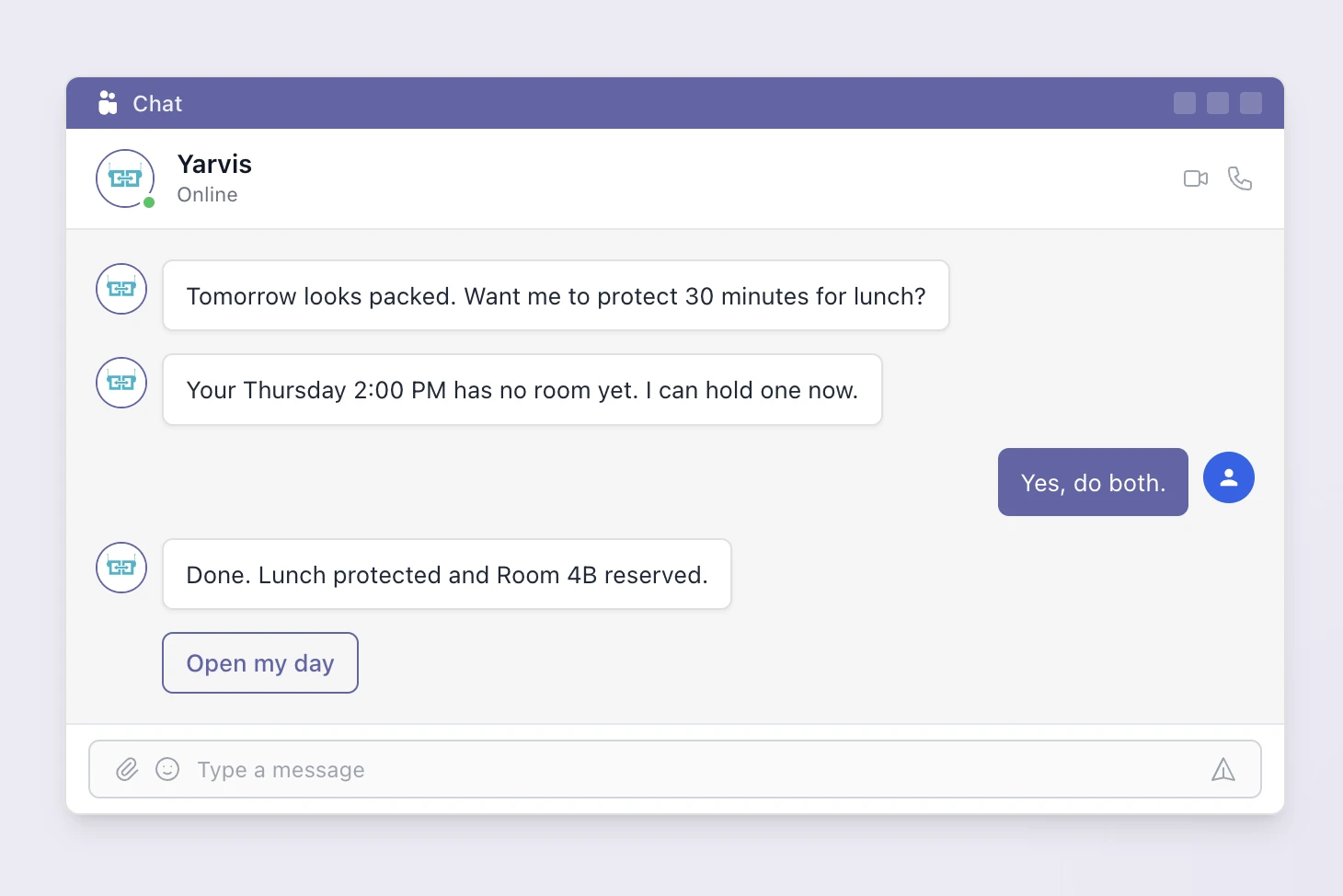
What Yarvis handles:
- Desk and room booking: “Book me a desk near the marketing team tomorrow” or “Find a room with a projector for 10 people at 2 PM.”
- Multi-resource coordination: one message can include recurring, multi-person booking requests across desks and rooms.
- Visitor management: CC Yarvis on a guest email and it can create the visitor pass, reserve parking, and send directions.
- Team scheduling: Yarvis can check calendars and coordinate scheduling in one conversational flow.
- Facility requests: “The projector in Room 4B stopped working” can be logged and routed without manual handoff.
- Automatic check-in: badge at the gate and Yarvis can apply check-in context for the day.
How it’s different from a basic chatbot:
Yarvis is designed around action, not just answers. It can execute cross-workflow tasks from conversation and keep context across requests. It also learns user preferences over time, so requests like “book my usual” become practical shortcuts.
The adoption point is central: employees already know how to send a Teams message or CC an email thread. That reduces tool switching and removes onboarding friction for routine workplace tasks.
Will AI Replace Facilities Teams?
Short answer: no. Longer answer: AI changes what facilities teams do, not whether they exist.
Facilities professionals currently spend a significant portion of their time on operational coordination, responding to booking requests, generating space reports, managing visitor logistics, and troubleshooting room technology. These are exactly the tasks AI handles well.
Gartner AI productivity estimate shows roughly 5 hours saved per person per week on non-value-added tasks (Gartner, 2025). For a facilities team of five, that is 25 hours per week redirected from coordination to strategy.
What AI can’t do:
- Design workspace layouts that support company culture
- Negotiate with landlords and vendors
- Handle emergency facility situations
- Build relationships with employees to understand unspoken needs
- Make strategic decisions about real estate portfolio
The most effective facilities teams in 2026 use AI to automate the operational baseline, then invest their freed-up time in strategic initiatives: sustainability programs, employee experience design, space optimization planning, and workplace culture building.
AI does not replace the facilities manager. It gives them a team of tireless digital assistants handling the routine so they can focus on what humans do best.
What’s Coming in 2026-2027
The workplace technology landscape is shifting quickly. Here is what the data says about where it is heading in 2026 and 2027.
1. Agentic AI Will Move from Pilot to Production
- Gartner predicts 40% of enterprise applications will include task-specific AI agents by end of 2026, up from less than 5% in 2025.
- Gartner also projects that one-third of agentic AI implementations will combine multiple specialized agents by 2027, which matters for cross-system workflows in workplace, HR, and IT.
- Deloitte projects that 50% of enterprises already using generative AI will deploy autonomous agents by 2027, up from 25% in 2025.
- Execution risk is real, Gartner expects over 40% of agentic AI projects will be canceled by end of 2027.
For workplace teams, the implication is practical: prioritize agent workflows tied to measurable outcomes like room-booking accuracy, no-show reduction, and faster visitor check-in.
2. AI Usage at Work Is Now Mainstream
- Gallup reported that 45% of U.S. employees used AI at work in Q3 2025, up from 40% in Q2.
- By Q4 2025, Gallup reported 26% frequent AI use and 12% daily AI use among U.S. workers.
- Stanford HAI’s AI Index reports that 71% of organizations used generative AI in at least one function in 2024, more than double 2023.
- Microsoft Work Trend Index 2025 reports that 81% of leaders expect agents to be part of their AI strategy within 12 to 18 months.
This is why workplace AI should be designed around channels employees already use, Teams, Slack, and email, not separate portals.
3. Office Utilization Is Rising, So Coordination Complexity Is Rising Too
- CBRE’s 2026 benchmarking reports that global building utilization reached 53% in 2025, up from 38% in 2024 and 35% in 2023.
- CBRE also reports that 68% of employees come to the office mainly to collaborate, increasing pressure on rooms and shared collaboration spaces.
- JLL reports workers globally are in-office for just over three days per week on average, which creates uneven mid-week demand peaks.
- In the same CBRE 2026 study, 80% of CRE teams named portfolio optimization as a top priority.
For teams running desk booking and meeting room management, this means static booking rules are no longer enough. Dynamic recommendations and auto-release logic become baseline capabilities.
4. Economic Pressure Will Favor Practical AI, Not Experimental AI
- PwC’s 2025 AI Jobs Barometer found that AI-exposed industries saw 27% growth in revenue per employee versus 9% in less exposed industries.
- The same study reports a 56% wage premium for jobs requiring AI skills, up from 25% the year before.
- PwC also reports that skills are changing 66% faster in AI-exposed occupations.
Translation for facilities and workplace leaders: AI projects that reduce manual coordination time, improve space utilization, and improve employee experience will win budget. Generic chatbot projects likely will not.
5. What Teams Should Expect Next (Late 2026 Through 2027)
Near term (next 6 to 12 months):
- More conversational, action-taking workflows for desks, rooms, visitors, and parking in one thread
- Better attendance-aware recommendations in hybrid scheduling
- AI-generated operational summaries for workplace analytics
Mid term (12 to 24 months):
- Multi-agent orchestration across workplace, HR, and IT systems
- Stronger policy automation, including compliance-aware booking controls
- More AI-assisted space planning and scenario modeling before lease or floorplan decisions
The Data Advantage
The organizations investing in AI-enabled workplace management now will have a data advantage as these capabilities mature. Historical booking and utilization data drives better predictions, and better predictions drive better space decisions. Teams adopting practical AI workflows today are building the dataset that will power autonomous workplace operations by 2028.
Last updated: March 2026. This guide is reviewed quarterly to reflect the latest AI capabilities across workplace management platforms.
Related reading
- AI Workplace Agent for Microsoft Teams: What It Is and How It Works
- What Is Desk Booking? The Complete Guide for 2026
- Workplace Occupancy Data: What It Is and How to Use It
- Hot Desk Booking in Microsoft Teams: 2 Options Explained
- Why Meeting Room Analytics Matter in 2026
- 8 Things to Consider When Choosing a Desk Booking Solution in 2026
Frequently Asked Questions
See it in action
YAROOMS brings desk booking, room scheduling, visitor management, and analytics into one platform your team will actually use.