
The 2026 Guide to AI-Ready Workplace Management Software

Your employees are already using AI to draft emails, summarize meetings, and research competitors. Some of them are probably doing it right now.
But ask those same employees to book a desk for Tuesday, find a room for twelve people with a video screen, or coordinate an in-office day across a distributed team, and most of them are logging into a separate app, navigating a floor plan, and hoping nothing is double-booked by the time they get there.
Workplace management software was built to be a system of record, a place to store who booked what, when, and where. That was fine when software’s job was to wait for humans to navigate it. But that expectation has quietly shifted. AI agents have trained people to just say what they need and have it done. Software that requires a separate login, a training session, and a deliberate context switch is increasingly software that simply does not get used.
So the question organizations should be asking when they evaluate their workplace management stack has changed. It is no longer “does this platform have good features?” Almost all of them do. The real question is: will your workplace platform still matter when AI becomes the primary way employees get things done?
This article looks at the leading workplace management platforms through exactly that lens. Not which one has the best floor plan builder, but which ones are genuinely building for the AI-native workplace (and what that means for the decisions you are making right now).
Why 2026 Is a Turning Point for Workplace Technology
The workplace management software market was valued at $2.64 billion globally in 2025 and is projected to reach $10.3 billion by 2035, growing at a 14.6% compound annual rate. The broader IWMS (Integrated Workplace Management System) market is already larger, estimated at $7 billion in 2026, on track for $13.5 billion by 2031. This is not a niche category. It is becoming a critical enterprise infrastructure, on par with HR software and ITSM platforms in the organizational technology stack.
What is driving that growth is the collision of three forces:
- Hybrid work has made office coordination genuinely complex. 77% of companies now operate hybrid models, but the operational reality is still messy, global office utilization averaged just 43% in Q2-Q3 2025, and while 44% of real estate decision-makers now mandate five days in the office, average attendance still hovers around three. Policy and reality are not the same thing.
- Real estate costs are forcing organizations to actually measure their space, not just assume it is being used. Up to 30% of room bookings go unused and 37% of meetings are no-shows, meaning organizations are making multi-million-dollar lease decisions on data that does not reflect how people actually show up. Attendance clusters on Tuesday through Thursday, leaving Monday and Friday near-empty while Wednesday hits capacity. Static booking systems cannot solve that paradox.
- AI has raised the bar for how enterprise software is expected to behave. Gartner predicts that 40% of enterprise applications will include task-specific AI agents by the end of 2026, up from less than 5% in 2025, and CIOs have been warned they have a three-to-six month window to define their agent strategy before competitors pull ahead. Most workplace platforms have not caught up yet.
What AI Ready Actually Means
Before we get into the platform comparison, it is worth clearing something up.
Not all AI features are created equal. In workplace management, “AI” can mean anything from a utilization chart that flags an underbooked floor to a fully autonomous assistant that books rooms, manages visitors, and sends calendar invites without you lifting a finger. Understanding where a platform sits on that spectrum is what makes evaluation actually useful.
Think of it as three levels:
- Level 1 - AI-informed: The platform uses AI to surface insights and make recommendations. Occupancy forecasts, anomaly detection, suggestions to consolidate underutilized floors. Valuable, and many organizations are not fully using this yet, but ultimately passive. A human still has to act on everything it surfaces.
- Level 2 - AI-assisted: AI helps employees move faster within the platform. Smart room suggestions, natural language search, autocomplete for recurring bookings. These reduce friction at the point of interaction, but the employee still has to open the platform in the first place.
- Level 3 - AI-agentic: This is where it gets interesting. The AI does not just suggest, it does. “Book me a desk near the product team for Thursday” returns a confirmed booking. “Set up a client visit Friday afternoon” triggers a visitor pass, a room reservation, a parking spot, and a directions email to the guest, all from a single message, in whatever tool the employee was already using. This is the level that makes workplace management effectively invisible.
AI Readiness Evaluation Framework
Before presenting the vendor comparison, here is the framework used to assess each platform. These seven dimensions represent the full picture of AI readiness in 2026.
- Conversational AI agent. Is there a named, productized AI agent? What channels does it operate in, Teams, Slack, email, or only within the platform itself? What is the scope of actions it can take?
- AI analytics and natural language querying. Can workplace leaders query their data in plain English (“which rooms had the most no-shows last month?”) and receive usable answers, or are they limited to pre-built dashboard views?
- Agentic depth. How many steps can the AI chain together without human input? Single-step (book a desk) versus multi-step cross-resource coordination (book desk + visitor pass + parking + calendar invite + directions email) is the critical differentiator.
- AI-powered space planning and forecasting. Does the platform use AI for strategic real estate decisions, scenario modeling, predictive occupancy, lease optimization? This is the executive and CRE-facing dimension that determines whether the platform is useful beyond daily operations.
- MCP and AI interoperability. Does the platform publish an MCP server, enabling external AI agents to connect and take actions natively? This determines whether the platform is part of the emerging agentic AI ecosystem or isolated from it.
- Adoption friction. Does the AI live inside tools employees already use daily, or does it require navigating to the platform? This determines real-world usage rates, not just feature availability.
- AI roadmap velocity. Are features in production, in early access, or on a stated roadmap? How frequently is the vendor shipping AI capabilities? A cadence of meaningful releases is a better signal than a single announcement.
The Three Tiers: A Map of the Workplace Management Software Market
The leading workplace management platforms today fall into three distinct tiers of AI readiness:
- Tier 1 - AI-native. Platforms where AI is central to the product strategy and actively shaping the roadmap. These vendors have named AI agents with agentic capabilities, and in some cases production MCP servers. AI is not just a feature layer here, it is increasingly becoming the primary way users interact with the platform.
- Tier 2 - AI-augmented. Platforms with meaningful, production-ready AI features embedded into an otherwise conventional product structure. AI enhances the experience and solves real operational problems, but the primary interface is still the platform itself.
- Tier 3 - AI-adjacent. Platforms where AI is still early, mostly limited to analytics and reporting, with more substantive features on the roadmap. These are solid, well-built products that do the fundamentals well. AI just is not where they are competing yet.
It is very important to note that this is not a ranking of overall quality. A Tier 3 platform may be the right choice for many organizations depending on their size, complexity, and readiness to adopt AI-native workflows. It is a map of where each vendor is positioned in the AI transition, and what that means for organizations evaluating them now.
| Tier | Positioning | What AI looks like in practice |
|---|---|---|
| Tier 1 - AI-native | AI is central to product strategy | Named assistants, agentic multi-step workflows, and in some cases production MCP interoperability |
| Tier 2 - AI-augmented | AI is strong but layered on a traditional platform experience | Useful production AI features for targeted workflows, with the core interface still app-first |
| Tier 3 - AI-adjacent | AI is emerging and not yet a core differentiator | Early analytics/reporting capabilities and roadmap-stage AI features |
Tier 1: AI-Native Platforms
YAROOMS (Yarvis + MCP), the Most Complete AI-Native Workplace Platform
Best for: Microsoft-first organizations that want AI embedded in their daily communication tools, with zero new app adoption required.
YAROOMS is notable for two things that do not often come in the same package: Yarvis as an AI agent with agentic capabilities, and an MCP server. It is AI-native and built to work with whatever AI tools your organization already uses.
The AI agent is Yarvis, and the framing from the beginning has been deliberately anti-app. Yarvis lives inside Microsoft Teams as a chat contact and can also operate over email via CC, no separate application to install, no new login to remember, no training required.
Employees interact with it the way they would message a colleague. It handles desk and room bookings, recurring reservations, team scheduling, visitor onboarding, emergency management, multi-resource coordination, and it can proactively suggest how to plan your day.
The MCP server, launched in April 2026, is the other significant development. MCP (Model Context Protocol) is an open standard that lets AI agents connect to external tools and data sources, effectively a universal plug that allows any compatible AI agent to interact with YAROOMS directly. Once connected, Claude, ChatGPT, or any other MCP-compatible AI tool can handle the full range of YAROOMS actions, booking, modifying, cancelling, checking availability, directly from within those tools. YAROOMS is the first and currently only workplace management platform to have shipped this.
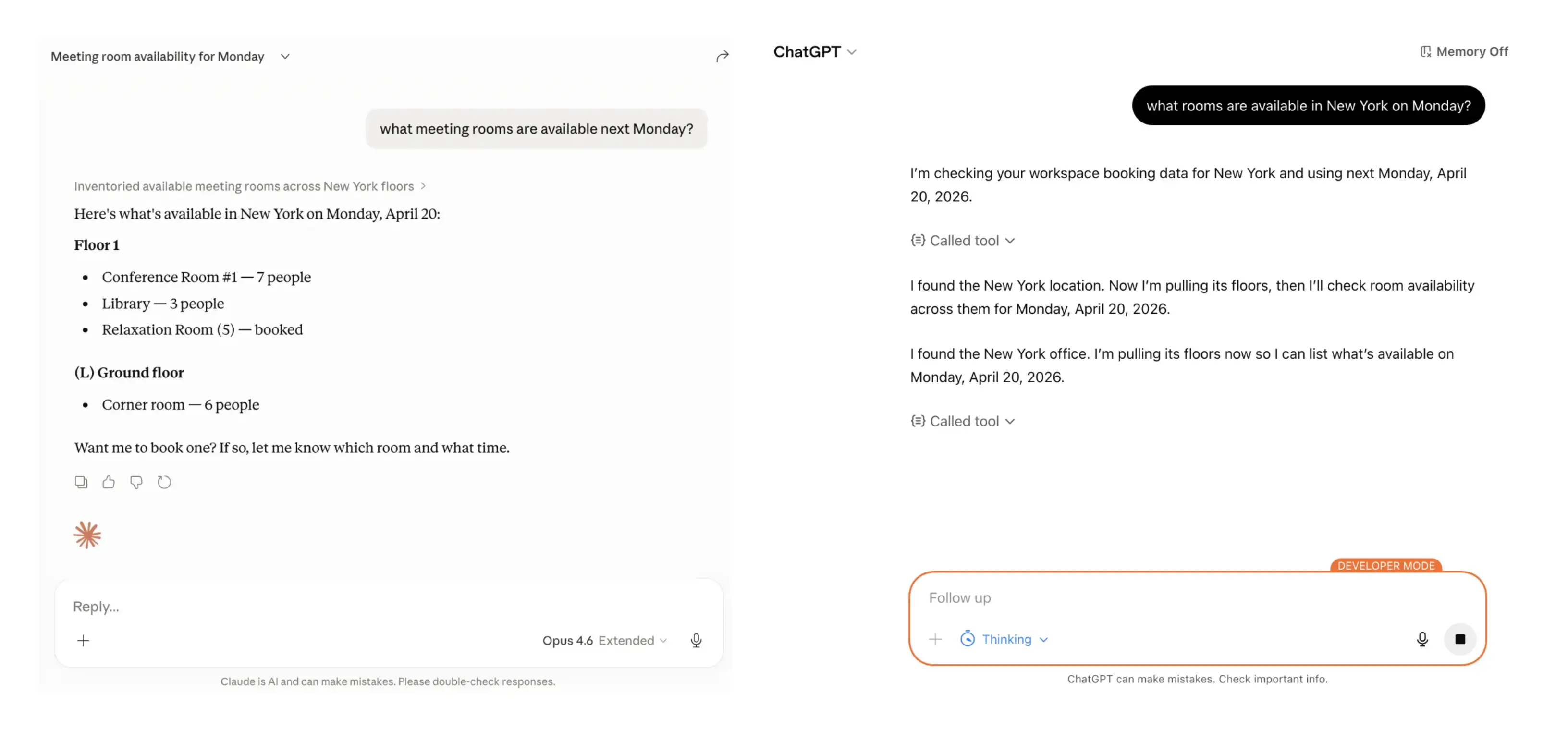
YAROOMS MCP in action: Claude and ChatGPT examples
One limitation worth noting: YAROOMS’s AI story is primarily about employee experience, operational coordination, and solving the adoption problem. If strategic real estate intelligence (scenario modeling, portfolio-level forecasting) is your primary need, solutions like OfficeSpace go deeper there.
Envoy, Security-First With AI Analytics and an MCP Vision
Best for: Security-conscious enterprises in regulated industries where compliance, visitor management, and audit-ready data are non-negotiable, and AI-informed space decisions are becoming increasingly important.
Envoy built its reputation on visitor management, and that reputation is still deserved. But the platform has evolved. AI-driven utilization tools give facilities managers a clear view of how space is actually being used versus how it is booked, with AI-powered recommendations surfacing directly in the floor plan editor, attendance forecasting informing resource allocation, and a rebuilt analytics platform delivering custom dashboards and ROI-focused benchmarking.
Envoy also has an MCP server, meaning external AI agents can connect directly to the platform and take workplace actions.
One limitation worth noting: Envoy’s AI is strongest in the analytics and space intelligence layer. There is no conversational agent for employees today, no “just ask for what you need” experience. For organizations whose primary need is employee-facing AI, Envoy is not the answer yet.
OfficeSpace Software, The AI Operating System for the Built World
Best for: Large enterprises (3,000+ employees) with complex real estate portfolios where AI-driven space planning, predictive utilization, and strategic scenario modeling are as important as day-to-day booking.
OfficeSpace has made the most ambitious AI pivot of any platform in this category. The company no longer positions itself as workplace management software, it calls itself an “AI Operating System for the Built World”, and the product backs that up.
The defining move was the October 2025 acquisition of Dojo AI, a patented AI platform for space planning and analytics. Enterprises using it have automated 30-60% of space planner workloads and increased occupancy by 66%. For teams making multi-million-dollar lease decisions, that is a different category of value than booking automation.
Beyond Dojo, the platform includes Ossie (an AI agent for natural language booking and insights) and the AI Canvas (a next-generation space planning interface).
Honest limitation: OfficeSpace’s AI is strongest in the executive and CRE layer, space planning, real estate strategy, predictive intelligence. Ossie operates within the platform rather than inside Teams or Slack, and MCP support has not been announced. For organizations whose primary need is conversational AI for everyday employees, YAROOMS would be a better starting point.
Tier 2: AI-Augmented Platforms
Robin - AI-Powered Workplace Operations
Best for: Enterprises with 500+ employees across multiple floors or locations that want AI to solve specific, high-impact operational pain points, scheduling conflicts and space analytics, within a mature, well-supported platform.
Robin sits closest to the Tier 1 boundary of any platform in this group. What is sharp about its AI approach is the focus. Rather than building a general-purpose assistant, Robin identified the specific problem burning the most time for workplace operations teams and built directly for that.
That problem is scheduling chaos. Robin’s own research found teams were manually rescheduling 400+ meetings per week, burning hours on conflicts, mismatches, and last-minute double-bookings. The Scheduling Agent, launched late 2025 and currently in early access, resolves what used to take 20 minutes in under 30 seconds. It is described not as a copilot but as an operator, an AI that actively manages meeting complexity rather than just responding to requests.
The Analytics AI Agent rounds out the AI story, letting users query their workplace data in plain language rather than exporting to spreadsheets. Practical, unglamorous, and genuinely useful.
A limitation worth noting: The Scheduling Agent is still in early access rather than general availability. Robin has not announced a conversational agent that works outside the platform, and MCP support has not been announced. It is a focused AI bet, not a broad one, which is either a strength or a gap depending on what you need.
Kadence, A Single Platform for Planning, Scheduling, and Space Intelligence
Best for: Mid-enterprise to enterprise organizations that need both a conversational AI experience for employees in their daily tools and executive-grade AI scenario planning for real estate strategy.
Kadence has built a two-sided AI story. On the employee side, Kadence AI handles desk booking, room reservations, visitor invites, and schedule coordination directly from Teams or Slack. On the strategy side, SpaceOps brings scenario planning, move management, and stack planning into a single AI-first interface, letting real estate leaders model “what-if” decisions in minutes rather than weeks. The two sides connect: visitor activity from the VMS feeds directly into SpaceOps as a utilization signal, giving leaders a complete picture of how their space is actually being used.
Worth noting: Kadence is a platform that rewards commitment. The more of it you use, the more value you get, but that also means organizations with simpler needs may find themselves paying for capabilities they are not ready for yet.
Eptura, Solid Platform With Uneven AI Capabilities
Best for: Large enterprises (5,000+ employees) that need a unified platform spanning workplace experience, facilities management, asset management, and strategic space planning.
Eptura is the most complex vendor in this evaluation, a global worktech company that owns Condeco (room and desk booking), Archibus (IWMS and facilities management), Serraview (space planning), and Eptura Engage (hybrid workplace experience). 25 million platform users and a 2026 Gartner Magic Quadrant Leader designation. The scale is real.
The AI story is real too, just unevenly distributed across the portfolio. The most mature piece is the Condeco Copilot for Microsoft Teams, a conversational agent for room booking, visitor management, and workday planning in natural language. The Technician Copilot adds voice-enabled, hands-free assistance for field maintenance teams, and facial recognition delivers touchless visitor check-in for high-security locations.
The broader AI roadmap, agentic AI across the portfolio, workplace automation, predictive ecosystems, is organized and ambitious. But it is a roadmap.
Honest limitation worth noting: AI maturity varies significantly depending on which Eptura product you are primarily using. Evaluate the specific products you will actually use rather than the portfolio as a whole.
Tier 3: AI-Adjacent Platforms
Skedda, Booking Governance Done Right, AI on the 2026 Roadmap
Skedda is a highly-ranked workplace management platform and a consistent leader in usability and support. Its rules engine is the deepest in the category, booking quotas, eligibility conditions, role-based access, approval workflows, multi-location policy enforcement, and its customer base reflects where it competes well: organizations that need strict, reliable booking governance above all else.
On AI, Skedda is honest about where it stands. The 2026 product roadmap explicitly names an AI-Driven Insights Agent, a chat-based interface for querying booking and utilization data, pulling reports, and getting space recommendations, as a major upcoming release. That is Level 1 AI: analytics and insights, not agentic actions. It is a meaningful step, and the intention is clear. But it is still on the roadmap.
For organizations where booking governance is the priority, Skedda remains a strong choice. For those where AI is a near-term requirement, it is a platform to watch rather than one to bet on today.
deskbird, AI Recommendations in Early Form
deskbird is a well-regarded mid-market platform serving over 5,000 offices globally. Deep Microsoft 365 integration, ISO 27001 and SOC 2 certification, GDPR-compliant hosting in Germany, and a clean user experience that consistently earns high adoption scores.
The AI story is early but real. deskbird offers AI-generated recommendations on when to come into the office based on booking behavior, colleague patterns, and scheduled events, a Tier 1 capability that surfaces useful suggestions without taking action. A $23M Series B raised in 2025 is explicitly earmarked for advancing AI capabilities and converting space usage data into actionable business intelligence. The foundation is there, the more substantive AI features are still being built.
All in all, deskbird is a solid choice for Microsoft 365-centric hybrid teams in the 200-1,000 employee range that want reliable analytics and are willing to grow into AI as the platform develops it.
How to Choose the AI-Ready Workplace Platform for Your Organization
The right platform is not the one with the most AI features. It is the one whose AI maturity matches where your organization actually is, and where it is heading in the next two to three years.
Before shortlisting vendors, answer these four questions honestly:
- How do your employees currently use AI? If your team already relies on AI agents daily, the expectation that those same tools can handle workplace tasks is not far behind. A platform whose AI lives inside Teams, Slack, or email will get used. One that requires opening a dedicated app will compete with everything else already open.
- Who needs AI more, employees or leaders? Some platforms are built to make the employee’s day frictionless. Others give executives and real estate teams the intelligence to make better space decisions. The right answer depends on your most pressing problem.
- How complex is your real estate footprint? AI-driven space planning and portfolio scenario modeling are genuinely transformative at scale. For smaller organizations, they are often overkill, and the platforms built around them tend to reflect that in price and implementation time.
- Is AI a current need or a future one? If your organization has not standardized on an AI agent and primarily needs reliable booking that people will actually use, choosing the most AI-forward platform is likely the wrong call. Pick solid fundamentals and a credible roadmap. You can grow into more.
Wrapping Up
The workplace management software market is undergoing its fastest transformation since the shift from on-premise to cloud-based booking. The gap between Tier 1 and Tier 3 platforms in this evaluation will widen significantly over the next 12 months. Features that are currently differentiators, conversational AI, agentic multi-step coordination, MCP interoperability, will become table stakes.
The most important reframe for any organization evaluating this market: stop asking which platform has the best booking UI, and start asking which platform fits best into the AI-native enterprise of 2027. Those are increasingly different questions, and the answers are increasingly different platforms.
Research for this article was conducted in April 2026. Vendor features and roadmap status are accurate as of that date and subject to change.
Workplace of the future. Today.
See how YAROOMS integrates with Microsoft 365 to create a seamless workspace booking experience.